Sunday, March 22, 2020

Verses, Verses Everywhere... but the stories are even better.


I have been reminded of late of good King Josiah, who was 8 (read :EIGHT) years old when he took over for his assassinated father, Ammon, who succeeded the disastrous rom King Manasseh. Josiah, however "did was was right in the eyes of the Lord." After he was older, one of the things Josiah did "right" was to repair, refurbish, and otherwise restore the Temple that King Solomon had built a couple of hundred years before.  

Image result for king josiahDuring that project--and I hope you remember this story from Sunday School--a copy of "the Book of the Law"was found under the Temple's clutter. Upon reading it, and realizing how unfaithful the people of Israel had been (not least during the reigns of his father and grandfather), Josiah tore his clothes (as sign of great grief and repentance), and commanded that the people hear again God's word and renew their covenant to live faithfully as God's people. 

It is one of the great stories in all the Bible--and one with shockingly enduring applicability: how the Bible is often lost or buried, even in the Church: is hidden under the clutter of so many other things. How many of God's own people--people who claim God, anyway--disregard the Word that gives Life, and that abundantly. How even the priests and rulers among us do not remember or know the ways and will of God.  

That is a sermon for another time. 

But there come moments, don't there, when we turn again to the text: we lose the job, get the diagnosis, watch the marriage or finances disintegrate. We have nowhere else to turn and so we turn to the Bible, though sometimes we are unsure where to look or what to look for; bu there is a sense we all of us have that here, here, is what we really need. We desire to read and listen and draw comfort (but leave the challenge till later). 

Now is one of those times, of course. And so many people are busing finding a verse here, a verse there, verses...verses, verses everywhere...to read, and to offer as balm, as comfort, to frightened souls in this weird, wilderness time. And good for you. Keep looking. Keep reading.

All I will say is that for me, isolated verses do not bring as much comfort as the themes, the narrative arcs—what scholars sometimes call “typologies.”

Which is why I am encouraged, cheered, to remember that the story of God’s people is very often a story of displacement, of one form or the other—of exile from the places and things that have given identity, but don’t anymore. Displacement, which calls for even greater reliance on God.

Image result for abram's journey from Ur
from Pinterest.es
For example, do you remember how God called Abram and Sara to leave the carapace of Ur in the Chaldees and go to a new land? Away from Abram’s father’s land and people, and everything that was part and parcel of his old life. That theme carries on…

When the people of Israel were Exiled from Jerusalem, away from the Temple and its priests, its worship and customs, traditions and songs--and BACK to Babylon. It is almost as if they were reversing Father Abraham's course.  

As surely as we are exiled, too, away from here from our place, our people, our songs and rituals. We can almost begin to sense, in the least wee sense, that since of displacement that caused the Psalmist to lament: 

“By the waters of Babylon, there we hung up our lyres and wept when we remembered Jerusalem. How can we sing the Lord’s song in a strange Land?" 

That is the question for us, even now, isn’t it?

Displacement. I remembered how Jesus called the disciples away from everything that was familiar: the water, their hometown, home synagogue; their family, work, routine…call it social distancing.

I have even thought about the Exodus: how slavery had been a horrible, but familiar carapace or cocoon: a kind of unsafe, safe harbor. And once they were free of it the people did not know what to do.

Like we do not know what to do, now that we, like they—and like the disciples were—are displaced from our offices and routines and our extended families; from our work, some of us, and our ways of working, others of us.

For forty years, those ex-slaves had to depend on God day-by-day to provide what they needed to survive and learn and be the people of God in the wilderness…

And in this wilderness, the wilderness we are now in, thank God for the day-to-day gift of Bible, and prayer, and hymns and songs and spiritual songs… yes, yes, of course.

Bible. Spirit. Prayer. Those basic things, left to us through the centuries when our own Temple has been cleansed, restored, repaired, renewed. For all we have thrown away of the church as it was (so many gilded ossifications and leaden overlays as to render the Church itself, much of it, a kind of carapace that needed discarding) we have never abandoned Bible, Prayer, Spirit. And we need them more than ever even now.     
Image result for holy communion
northwood-umc.org
          
But if we are not careful, will take those comforts to our own soul--make our personal manna a private meal; our individual salvation private. 

But in fact, in the stories, every instance the Bible’s people were displaced, they were still together. In families—Abram and Sarah; among the Exiles, marching along their own Trail of Tears to Babylon; the first disciples—Jesus’ call never left anyone alone: they had to be in the group; even the people in the wilderness: they were in the wilderness together. 

Over and over again they ate together: Passover, Seder, Table Fellowship, Eucharist--all, quite literally, a fore-taste of the Glory Divine. 

Paul was never alone, either, even in jail!

Which is why we, too, have to find ways to keep connected. With Bibles and hymnals and prayer books in hand, of course--but looking for others to read with, pray with, sing with, because our faith is a corporate thing. 

Personal, but never private. So thank God for technology, and phones, and emails… all are crucial.

But keep looking for even other ways to connect and stay connected.
          
Whatever we are forced to give up in this displaced and displacing time, let us never give up on the hope and need to be together again.   

Friday, March 20, 2020

John Baillie, Gandalf the Grey and Albert Camus

Image result for a diary of private prayer
From Amazon.com
No offense to Susanna Wright, at all. In fact I am pleased she has made A Diary of Private Prayer available and accessible once again to
a new generation of believers. Indeed, the language and rhythms of the original--so Scottish, so Calvinist, so stately--can be off-putting to some folk (I once gave a paperback of the classic to a friend named Celeste who scanned a page or two and handed it back to me: "I don't talk like that!"

I told her that was the power of it, or part of the power: to make your mouth say words they don't always say, in an order and cadence that is more like music than banter. Like the Psalms, I said. She was uninterested. It was oasis to me, but some people find it dry and gritty. So, thanks, Susana. Tell Tom I said "hello."

That said, this morning's prayer loses something in her translation from the original to the updated.

In the newer rendering:

"Almighty God, in your infinite wisdom you have sent my life with the narrow bounds of time and circumstance..." 

In the copy I have, which has almost not survived my praying of it through many long years and many dark nights, the prayer begins this way:

"Almighty God, who on Thine infinite wisdom hast ordained that I should live my life within these narrow bounds of time and circumstance, let me now go forth into the world with a brave and trustful heart." 

No, Celeste, I don't talk that way, either, but I surely wish I did. So, I guess this morning I let Dr. Baillie speak for me as well as pray for me.

"These narrow bounds of time and circumstance." And today, of course that takes on new meanings as we continue to get the numbers on COVID-19... and people are going crazy.

Not that there are riots or anything.... but you have senators betraying the public trust, apparently, greedily using dire information that have heard in classified briefings to protect their portfolios... at least that is the allegation. You have people in Kansas and Louisianna and cyperspace denying, doubting, entertaining the wildest kind of conspiricy theories...and it all is a hoax, right? An international collusion of financial markets, health officials, even hospitals and morgues that are running out of room--oh, yeah, and "the media," as it that is one monolithic thing--to besmirch the President. Who is now telling people not to sit so close together, so I guess he's now in on it.

Crazy times. Interesting times, at the very least, which is the old Sufi curse: "May you live in interesting times."

Praying Dr. Baillie this morning--these narrow bounds of time and circumstance"--I was reminded of the conversation between Gandalf and Frodo, as they sat in the mausoleum-like gloom of Moria, contemplating the evil and darkness that had overtaken Middle Earth: "I wish it need not have happened in my time," said Frodo. "So do I," said Gandalf, "and so do all who live to see such times. But that is not for us to decide. All we have to decide is what to do with the time that it given to us."

What resource do we have? Where do we find wisdom and strength? Dr. Baillie prays for us, and this morning I pray with him and many others who are using this prayer book for Lent:

"It has pleased Thee to withhold from me a perfect knowledge; therefore deny me not the grace of faith by which I may lay hold of things unseen" (Wright: "It has pleased you to hold back from me a knowledge of everything; therefore give me the grace of faith so that I may grasp what I cannot see.")

Thou has given me little power to mould things to my own desire; therefore use Thine own omnipotence to bring Thy desire to pass within me: (Wright: "You have given me little power to shape things to my own desires; therefore use you own great power to make what you desire happen within me.")

Thou has willed it that through labour and pain I should walk the upward way; be Thou then my fellow traveler as I go" (Wright: "It is your will that through hard work and suffering I should walk the upward road; so be my fellow traveler as I go").  

"Let me face what Thou does send with the strength Thou dose supply... does that part of it need translation?

I, like Frodo, wish "this" need not have happened in my time. Like Gandalf, I remind myself and others that no one likes it, but what we do now reveals much about our faith and our understanding of God's call and claim on our lives. Like John Baillie, I pray for us all that When (God ) callest us to go through the dark valley, we will not persuade ourselves that we know a way around, whether iby unethical stock deals, hoarding of supplies, irresponsible gatherings, or denial.

+ + +

One more literary reference:  Really interesting article in the NYT yesterday: "Camus on the Corona Virus": https://www.nytimes.com/2020/03/19/opinion/coronavirus-camus-plague.html

Thursday, March 19, 2020


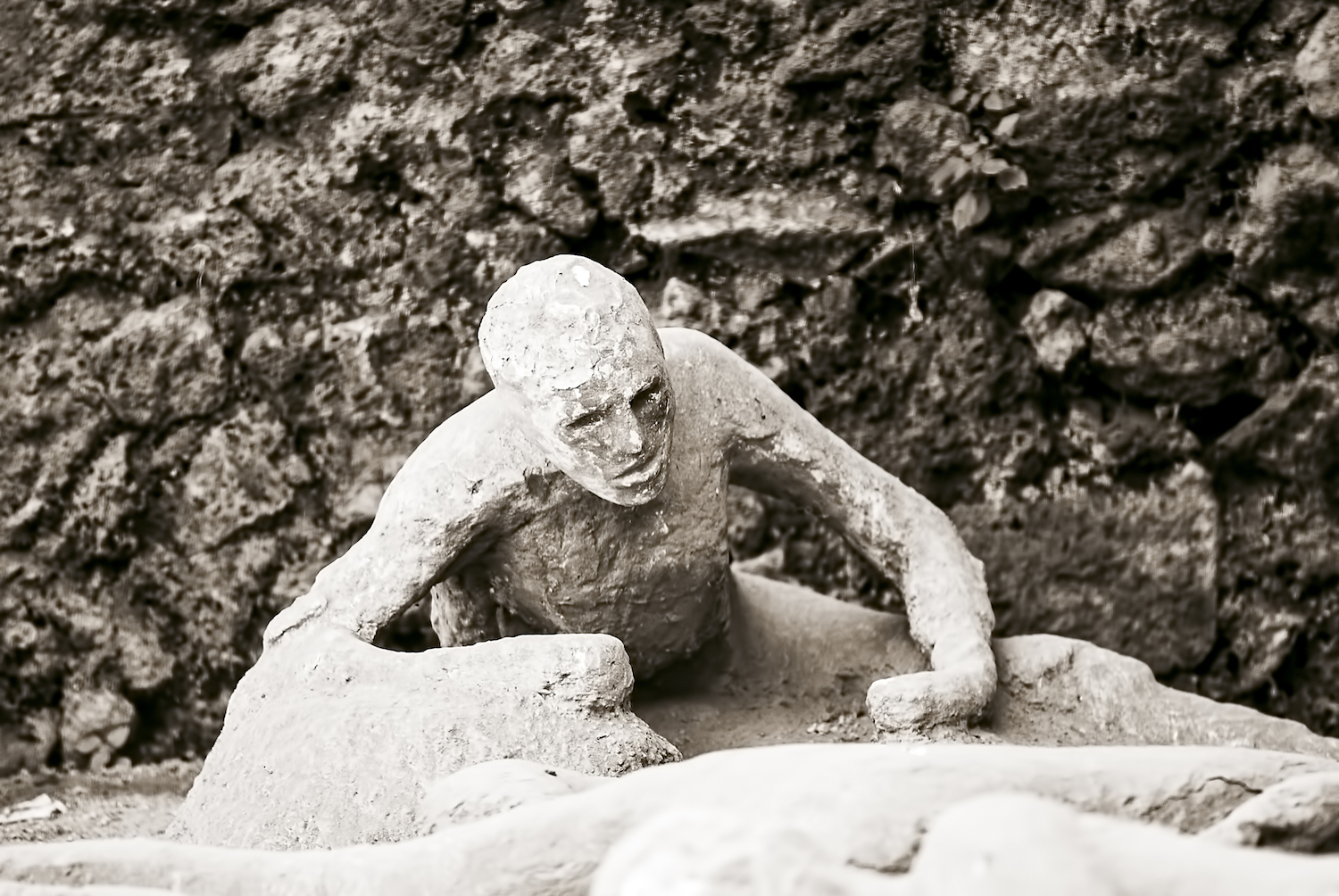
I have been thinking about Pompeii. About Hiroshima and Nagasaki. About those pictures we have all of us seen--and what some have seen up close--about the moment disaster struck: People caught in the middle of some activity and just... frozen. In mid-jump or whatever.

Image result for pompeii
from livescience.com
I have been thinking about that because it seems to me that that is what has happened to us, in a way. Not as dramatically, localized or instantaneously--and certainly not as catastrophically, at least so far--but perhaps as arrestingly: we were going about our lives, our business, church, more or less normally, and now we are stunned, stopped, trying to climb out from under it.

The guy to the left here speaks to me like sad poetry. And even if he should escape the wrath of Vesuvius, which of course he did not, what will his life, or the life of Pompeii, be like on the other side of it? 

Image result for hiroshima shadows
from Pinterest
The child to the right, mined from Pinterest, looks too "perfect," though I have not been able to find any indication that it is inauthentic. Even if it were staged or photo-shopped, the truth is beyond dispute (and what was it Picasso said? That art is a lie that helps us see the truth? I suspect the reverse is a good way to describe the gospel: the Truth that helps us see the lie of the world and its values). In any case, comes a moment that forever divides things into before and after, and we must try to cross the Rubicon of that moment and live into the new reality it signals.      

So, what will our lives be like on the other side of COVID-19? Who but God knows? But surely there will be some of what we learn and experience, even if most of if will fade.  

Those of you who are familiar with The Hunger Games, either the books or the movie, will remember that moment when Haymitch reads to Katniss the letter from Plutarch: "The war is over. We're in that sweet period where everyone agrees not to repeat the recent horrors. Of course, we're stupid, fickle human beings with poor memories and a great gift for self-destruction. Although, who knows? Maybe this time we will learn." 

Image result for haymitch reads to Katniss
from Pinterest.co.kr
I would like to think this time we will learn, though the track record is not great. I remember that sweet moment after the terrible horror of 9/11. I remember people being nice to each other, patient on the highways, going back to church and praying, rallying around brothers and sisters. Of course, it did not last, except for the kind of "never forget" prejudice that has spawned untold atrocities and still incites death and destruction. For Christians, forgiveness is a kind of forgetting and our desire is never to judge whole groups of people by their worst examples. THAT is part of what I wish we could learn, and remember, and keep before us...

What else would I like for us to learn? That we really do need each other. We are not islands. Either as individuals, ethnic groups, or nations. We cannot wall ourselves off from others, nor should we want to. If, on the negative side, the virus proves how interrelated and fragile (and global!) we are--where strangers can infect strangers and no barrier is effective against sickness and death (all the neighborhoods in Pompeii, rich and poor were equally destroyed)--on the positive side, the ways we cooperate prove the same thing to the positive. We prove, together, how strong we can be. Strangers can help strangers; nothing can stop the love and sharing and service once it begins to spread.

I also hope we learn again how crucial church is. Not just going to church, but faith, hope and love. Being a part of the Body of Christ, where together we learn who our neighbor is and why we love them (because Jesus loved and died for all of us; no one of us, but all of us are his favorites). 

Where we are given both the reason and the example to "make ourselves useful," as our moms used to say when we were bored. If there are many who will gladly self-quarantine and safe-harbor in order to stay away from people (and certainly we each and all need to be responsible, for ourselves and others), there are also people who are so much self-quarantined but cut-off from support or help; many who are not only safe-harboring, but dangerously isolated. It is our duty and joy to learn from Jesus, and in this wilderness determine how to come away from our willful isolation in order to make ourselves useful to our neighbors by loving them for God's sake. 

We may learn more yet about what the Church will be or look like after COVID-19. I will speak to that more tomorrow. 

Yes, we have been stopped in our tracks, as it were. But Jesus calls us to follow him to the other side where even now we can prove to be his disciples.    


Wednesday, March 18, 2020

Foresight

General Conference, I have it on good authority, will not happen in May. It was scheduled for May 5-15 in Minneapolis, and I was to be there, blogging away. Nope. Canceling reservations even today.

I have my doubts about Annual Conference in June. I have it on that same good authority that bishops and cabinets are making plans to ordain folk only among family members and without the gathered many attending.

I hope to goodness the Doobies don't cancel. I was going to drive back from Junaluska on Friday of Conference week, anyway, to see them: their 50th anniversary tour, just elected to RRHoF. Please don't cancel, Doobs!

(Reba did cancel, but I wasn't going to see her anyway--though I think she might really like me if she ever met me. Of course, I think the same thing about Alison Krauss. I am very like Honey Thacker, in Notting Hill, who has long known that she and Anna Scott would be the best of friends, if only they might meet. Almost identically, like Honey, I can hear Reba, or Alison, when I explain all of this to them saying, "Lucky me.")

ENOUGH with the sidebars.

I am just thinking: for a long time I have heard what might be called ecclesiologial "futurists" talk about the eventual demise of the large, gathered congregation in favor of small groups, dinner churches--the kind of  house churches that were the locus of early Christianity, and the vehicle for many reform movements, not least the churches inspired by John Wesley. I have wondered whether, if they are right and have real foresight, the demise might result from gradual decline, attrition and such (we have in fact seem many church closures in the last decades), or if there would be a tipping point, something that triggered the move in more or less momentary fashion.

I am wondering if this is it? Or this starts it and another crisis finishes it?

Groups of 10? Sounds like a small group.

No more than 50? What's a megachurch to do?

But, if Christians gather around a table as God instructed the Hebrew slaves--a family, or if a family is too small, join with another family--and we read the stories and pray and have a Love Feast (a lay Eucharist), and maybe once a quarter gather in slightly larger numbers for Eucharist or a Baptism, people might decide they really like the feel and spiritual intimacy, without the buildings, bills, maintenance and upkeep, without the financial drain of staff and salaries and such. I may soon be a member of an endangered species--maybe I already am and don't quite know it. It may well be that the gospel of Jesus Christ works better away from the spotlights and megawatt smiles, and at the dinner table, the living room, where people can speak the truth in love, support and hold one another accountable, and focus on faithfulness, not on the many distractions that come with "church" as we have known it.   


Tuesday, March 17, 2020

St. Patrick's, Bonhoeffer, Joni Mitchell and COVID-19


In years past, this was the day of green beer and silliness. Bars and restaurants in Ireland, and in Irish Catholic neighborhoods in America, especially, used to be crammed with revelers; but an eerie silence has overtaken the revelry. Typically (think: Mardi Gras, Cinco de Mayo), the celebration was not limited to Irish Catholics (not everyone at Mardi Gras observes Lent; more than Mexicans celebrate Cinco de Mayo). Whereas festival used to be the order of this day, the Pubs in Ireland are dark and silent. The bars and restaurants in America, too.

Legend says that St. Patrick drove all the snakes out of Ireland—though the facts are more rather sober: the ice of those climes would have prevented their being snakes in Ireland. No matter.

Just saying, these are odd times: today, no parties or green beer, and for COVID-19’s sake, practice social distancing: do not get near enough to anyone pinch them, even if they are not wearing green.
+
I am awaiting an email from Bishop Leeland even as I write, but it will not surprise me if he suspends public worship for several more weeks. I hate that more than I can say, though I realize it is the right thing to do. But it has brought to my heart, poignantly, this word from Dietrich Bonhoeffer:

It is easily forgotten that the community of Christians is a gift of grace from the Kingdom of God, a gift that can be taken from us at any day—that the time separating us from the most powerful loneliness may be brief indeed. Therefore, let those who now have had the privilege living a Christian life together with other Christians praise God’s grace from the bottom of their hearts. Let them thank God on their knees and realize: it is grace, nothing but grace, that we are still permitted to live in the community of Christians today.
--Life Together, p. 30

Or, as Joni Mitchell put it, “Don’t it always seem to go, that you don’t know what you’ve got till it’s gone?”

I suspect that what grieves us so right now is that we do know how precious it is to be and worship and “live” together with our brothers and sisters at HLUMC. One of my hopes for this hiatus: that each of us will realize we miss even those people who, we can get together, get on our nerves; now, with all this social distancing, we will discover that we find we love them, too, will rejoice to see even them when we can. And hopefully. Soon, and very soon. But it will not be yet.

When we do get together—our first Sunday back—I am committed to a lawn party, a cook out, cakes, etc. Maybe even some green beer.

Okay, maybe not that on the church lawn. But later, at a reopened pub!

Wednesday, February 19, 2020

Getting Ready for Minneapolis!

REALLY LIVELY BIBLE STUDY TODAY!! On the future of the UMC! I was advocating for the Centrist Progressive position, and a Traditionalist took exception.

Actually, no. I was taking the Traditionalist position, and a Centrist Progressive took exception. Just ate some pavement while I was taking a walk.

Actually, no. I was trying to take no position and EVERYONE took exception.

Actually, no. A chicken, a possum and Tom walked into a bar; the chicken and the possum used the door (thanks to Sean). Actually: A nose piercing gone horribly wrong.

Actually, no. Here is the real talk: Since my prostate cancer surgery last July 8, I have gained 25 lbs. I used to walk 4+ miles every day, and over 5 many days. Since July I have
walked a total of about 3 miles...so no wonder I have gained the weight. But, I feel awful. And so, I have been saying for a number of weeks now: got to get back to walking. This week, for some reason, it happened. Today was my third consecutive day doing three plus miles, and I was within 100 yards of my door when I stepped on the edge of the sidewalk, rolled my ankle, and ate some concrete. Could have been a LOT worse. I did not break my nose or cheek. I do not bruise but will have a black eye, I suspect. I am sore. But, God willing, I will lace them on again tomorrow and head back out.

Which is why I think this does help me with Minneapolis. I think there will be days when we are face down on the concrete. I hope not, but I suspect it will be the case.

Further, today, lying prone on the sidewalk bleeding, two cars drove past slowly, perhaps thinking to stop, but not stopping. Later, as I ambled the last 100 yards to home, a jogger come the other way saw me, bleeding, and kind of sped-up to get past me. I have new insight to Luke 10: it may have been the blood.

In Minneapolis we MUST tend to each other. We have to see the hurt and help. Do No Harm means also not letting the wounds go untended.

In the next few blogs I am going to share some materials I have been teaching here on why I am a Centrist/Progressive. And why BIBLICALLY I find myself in that position. Which is to say: I think part of the impasse of the last however many comes to a stalemate of authority. The Traditionalists have discounted Reason and Experience in favor of a monolithic reading of the text (I use that term carefully and theologically; as in stone tablets, as in the letter of the law; as if the Law is one thing). The Progressives have abandoned Scripture and Tradition (as anachronistic, misogynist, oppressive). What we have not been able to do is find biblical grounds to counter a monolithic reading and provide a LIVING word that retains authority in what has been described as the Quadralateral.

I think the case for a Centrist to Progressive position is thoroughly biblical and I will share that line of thinking in the next few entries.

If you would like to see the whole piece now, email me at tsteagald@yahoo.com and I will send it to you electronically.

Now, another dram of bourbon as I change my bandages.

Saturday, February 1, 2020

No Argument Zone

I am officially declaring this blog a no argument zone.

My goal is to share my best thoughts, deepest prayers, purest love for Christ and his people, for the Church and its mission--in service of my determination to be the best pastor to the folk under my charge (and whoever might happen by here).

I will not debate, will delete argumentative comments.

I will share as I can my reading of Scripture, but in a spirit of humility and love: working out my own salvation with fear and trembling; working to count others as better than myself; doing nothing from selfish conceit...

I take a cue from Jack Lemon, whose priest character in Mass Appeal: "I have baptized you, counseled you, married and buried you; but I have never really cared enough to risk losing you" (his defrocked associate had chided him: "there has to be something more important than what your congregation think of you").

I too believe that "we must be allowed the freedom to shape this thing that has shaped us," and indeed I believe Scripture not only grants that freedom but in fact demands it. When the truth is not spoken, people are kept silent, inactive.

As Richard Hayes said, "Scriptural imagination is the faculty that enables us to see the world through the lenses of the Bible’s images and stories—and to be transformed by what we see. To exercise scriptural imagination does not mean living in a fantasy world where we ignore the daily realities around us; rather, it is to have our eyes opened to recognize that the story Scripture tells is the true story of the world. To look at the world through scriptural lenses is to have our vision corrected so that our illusions are stripped away and we see the world as it really is: created by a loving God but fallen into disobedience and alienation. Through the lenses of Scripture, we also see this real world redeemed and transformed by Jesus Christ’s death and resurrection. With our vision thus corrected, we can join Paul in discerning “that the sufferings of this present time are not worth comparing with the glory about to be revealed to us” (Romans 8:18). Additionally, scriptural imagination enables us to inhabit the story that Scripture tells. We read the Bible not just to find devotional tidbits, “illustrations” of something we already knew on other grounds, or general principles to shape our lives. Instead, we read it to learn the unfolding story in which we too are characters, and to understand the role we are called to play in it." (Duke Divinity Magazine, Spring, 2013)

Those who are in Charlotte are invited to come to our church on February 5, 2020, at 9:45 or 6:45, for a presentation as to the biblical/theological background to the impending "divorce" in our denomination.

On Sunday, February 9, after church we will have a congregational meeting to discuss he administrative side of the question. Again, you are welcome to attend (lunch will be served but you have to make a reservation).

Fishing for the Future

takemefishing.org I was supposed to go fishing this afternoon.  Didn’t happen, though. Bummer. I love to fish, though I do not...